
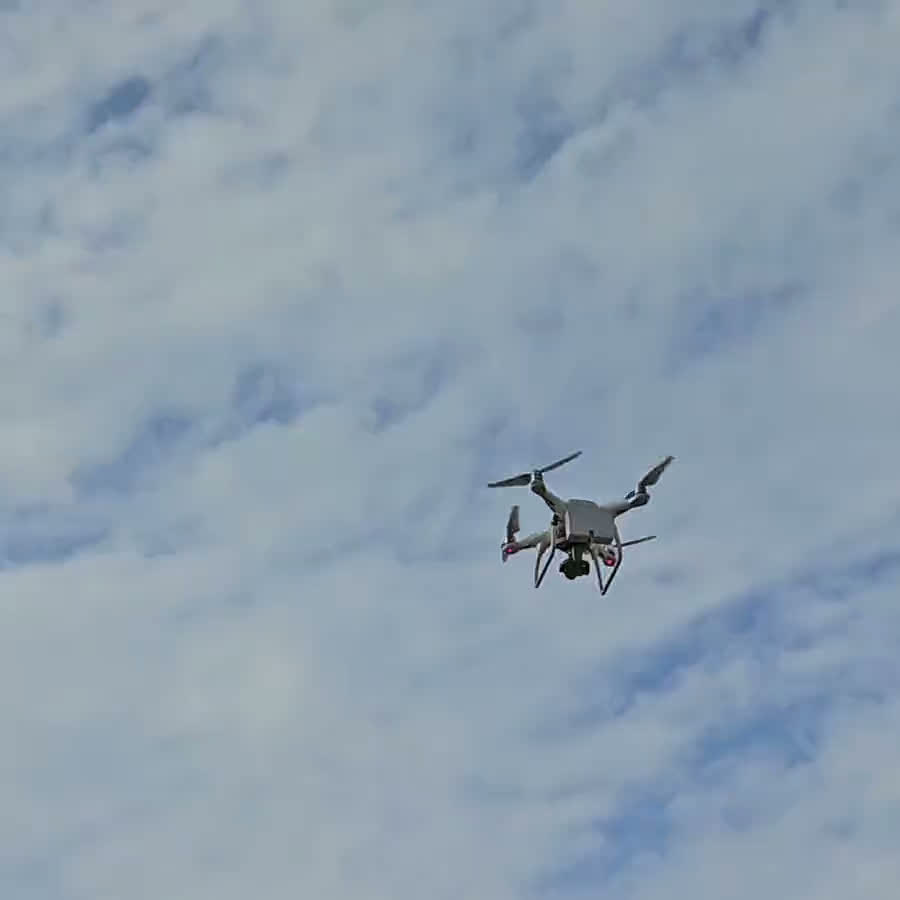
Counter-UAS / Undisclosed / 2026
A 25W sensor for drone detection, identification and direction finding
A deployable sensor that finds drones by their radio emissions, identifies them where they broadcast and classifies them where they do not, and takes a bearing on a target that is actively trying not to hold still — with everything, inference included, running on the node inside 25 watts.
Results
- 25W
- Total node power, inference included
Disciplines
- RF signal processing
- Edge AI
- Embedded systems
- Sensor fusion
Context
A counter-UAS sensor cannot assume the cooperation of what it is looking for. Cooperative identification is straightforward to disable, and the airframes that matter most are the ones that have disabled it. What is far harder to suppress is the link the operator depends on, which means the spectrum carries a signature even when every cooperative channel has gone quiet.
Working from that signature is difficult in a specific way. The bands are crowded, the interesting emitters are designed not to sit still in them, and the sensor has to stay useful at the edge of a network rather than at the centre of one. That last constraint rules out the obvious approach of moving the problem to where the computation is easy. A sensor that needs a rack behind it is not a sensor, it is a site.
Two problems in one sensor
The system answers two questions that are usually answered by separate equipment. Where an aircraft identifies itself, the sensor decodes that identification directly, across the published standards and the transports they run over. Where it does not, the sensor classifies the airframe and its control link from the emission alone, and holds the result as a track rather than a sighting.
Combining them on one node is what makes the output worth more than the sum. A decoded identity can be bound to a tracked emitter rather than merely sitting alongside it in an operator’s picture, and the sensor can say what it knows about an aircraft with the confidence appropriate to how it came to know it.
Letting the honest aircraft teach the classifier
The recurring obstacle in this field is not model architecture. It is training data: laboratory and synthetic captures do not resemble a real environment, and hand-labelling field recordings is slow enough that it does not happen at the volume required.
The cooperative path resolves this as a by-product of its ordinary operation. When an aircraft identifies itself and that identification can be attributed to a signal the sensor is already tracking, the recording of that signal is retained with the identity attached to it. The system accumulates correctly labelled, real-world training data from every deployment, at no cost in operator attention. The aircraft that broadcast honestly end up teaching the classifier to recognise the ones that do not.
Attention as the scarce resource
A single sensor has a finite amount of attention, and how it spends that attention is a more consequential design decision than any individual detection stage. Time spent confirming what is already known is time not spent finding what is not, and a sensor that fixates is a sensor that can be occupied deliberately by an adversary who understands it.
We made that budget explicit and adaptive in both directions. Evidence that something is present earns it more attention; evidence accumulated over repeated observation earns more still. But a confirmed target is never allowed to consume the sensor — a fixed proportion of its effort is held back for discovery regardless of what it is currently tracking. Classification carries a demotion path as well as a promotion one, so a track that stops agreeing with itself is presented to the operator as downgraded rather than left asserted. Confidence that only ever rises is not confidence.
Designing inward from the power budget
Twenty-five watts was fixed at the outset, not arrived at afterwards. It is what a unit can draw and still be passively cooled, run from the power available at a temporary site, and be carried and sited by one person. Every subsequent decision — what is computed continuously, what is computed only on evidence, what is held in reserve — was made against that figure.
Most of the work in holding it was not model optimisation, which is where this kind of engagement is usually expected to concentrate. It was in the control loops around the sensing chain, which had to be built rather than configured, and in the behaviour of a continuous real-time path sharing a small machine with everything else that needed to run on it. That second class of problem does not appear on a bench and does not appear in a profiler. It appears in the field, under sustained load, which is where we found it and where it had to be fixed.
Outcome
A working sensor that detects, identifies, classifies and takes bearings within a 25W envelope, publishing its output onto the wider platform for fusion with other sensors. Detection range and classification accuracy are the client’s figures to state, not ours.
The system was handed over documented to the level its own engineers need in order to extend it as new airframes and protocols appear — which in this domain is a standing requirement rather than a closing task — and its decoders are held to a regression suite built against known-good sources, so that a fault surfaces in testing rather than in front of an operator.